 Clarify
 Nederlands
 English
Block diagrams part 3
Redundancy

How sure are you of your case? What are the consequences of the primary process stopping unintentionally?
All the links in our process have been carefully chosen. Together they deliver the desired result.
What if a link no longer delivers?
Does the process then stop? Or does it become uncontrollable, or does quality drop? Questions we must answer in advance:
- How often will it happen that a link no longer functions, or functions less well?
What consequences does this have across the whole process in terms of reliability and availability?
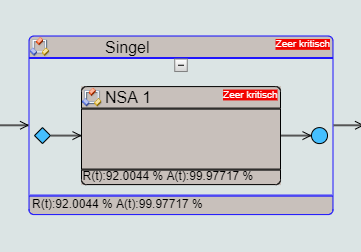
The block diagram gives you an immediate answer to this last question. If a link not functioning, or not functioning well, harms overall performance too much, we can consider addressing this link.
- We look for a replacement link with better properties, considerably increasing the chance of proper functioning.
- We keep a spare link ready so we can replace it quickly when needed.
- Another option is to build redundancy into the link concerned: placing two or more of the same links in parallel. These parallel links are, in this case, ‘spare’ and immediately take over the function if the primary link fails.
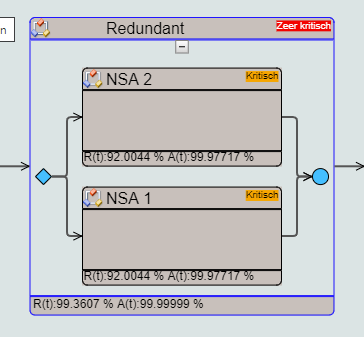
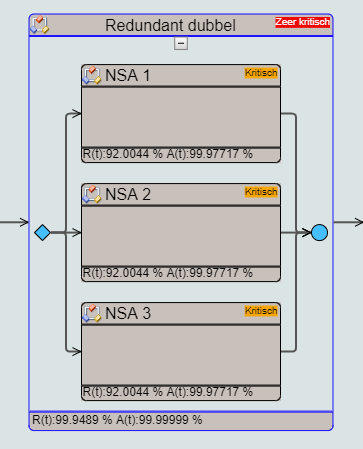
How do you assess the contribution of redundancy?
This placing of ‘built-in spare capacity’ is a technically expensive solution, but one that offers a great deal of certainty.
To substantiate this choice, we can see directly in the block diagram what such an investment brings in improving the reliability and availability of the whole.
The importance of the costs and returns of the primary process will be decisive in the choice of whether such investments can be justified. Risk-driven management fully substantiates such a choice.