 Clarify
 Nederlands
 English
Plan of action part 4
Risk management
In part 4 of our series ‘Risk Management Action Plan’ we discuss risk control. Because every organisation determines for itself how much risk it is prepared to take (the risk appetite), the risk standard for the organisation is thereby established. In risk-driven management we look directly at the outcome of the effects and the probability (in the risk matrix) when failure occurs. Outcomes in the risk matrix immediately give a picture of how heavily a risk is weighed.
Is it time to take action?
When risk is too high, we consider what we can do to reduce the risk. Always weighing up:
🔶 what is the desired performance?
🔶 what are the costs of reducing the risk?
🔶 and what is the residual risk, with its associated consequential costs?
With Clarify software you get an immediate indication of these ratios:
🔶 the performance is reflected in the effect columns
🔶 the residual risk is determined by the effects and probability after the measures have been taken
🔶 and the costs of the measures follow from the resources deployed to reduce the risk and the consequential costs.
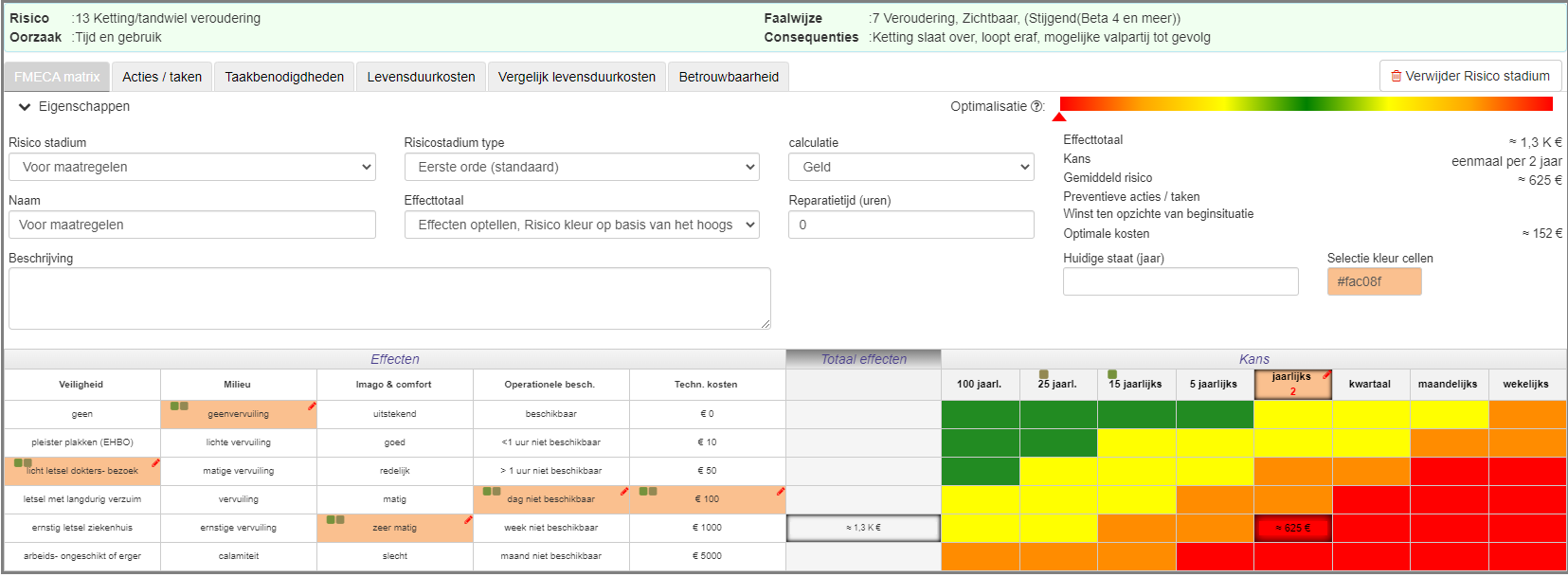
Ratio of performance, residual risk and costs
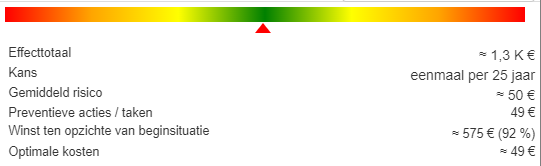
To make the deployment of resources effective and efficient, Clarify shows an optimisation bar and an accompanying calculation. This is how we steer towards optimal management.
Optimisation bar and calculation
Everything we do in management and maintenance is:
🔶 either determined by laws and regulations
🔶 or the result of risk management
Good to realise, and good to check whether that is also the case in your organisation.
Optimal management and maintenance consists of doing the right things at the right times at the most favourable rates. The optimisation gives us a good indication of whether we are doing enough, too much or too little.
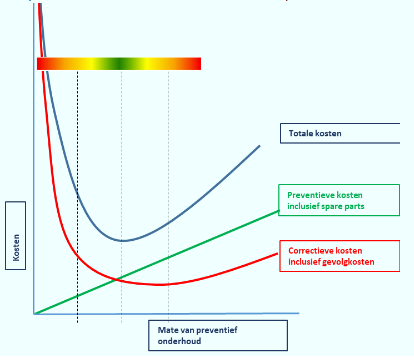
Optimisation of preventive and corrective costs
If we use these options in the design, we can also determine the optimal life-cycle costs directly.