 Clarify
 Nederlands
 English
Plan of action part 1
What is risk management?
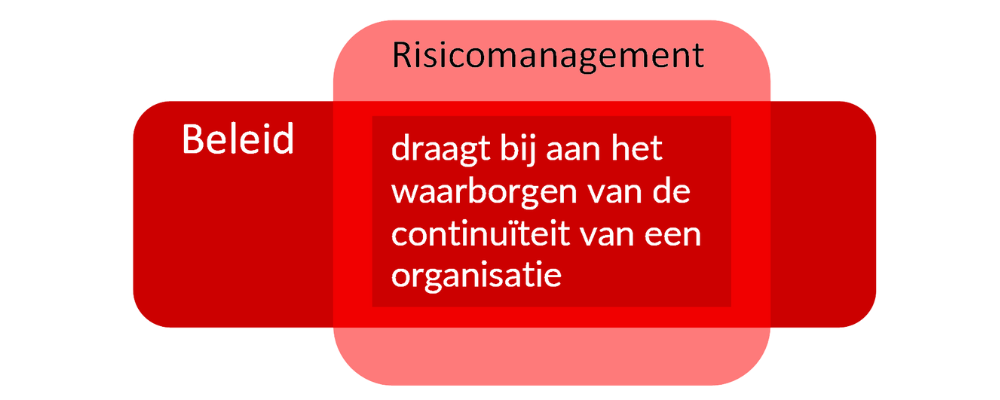
Risk management is the identification and quantification of risks within an organisation and the drawing up of measures to reduce or eliminate those risks. We all use risk management, sometimes consciously, sometimes unconsciously. After all, with almost every decision we make a trade-off. Shall we do it? And, if so:
- what are we going to do?
- how are we going to do it?
- and what may it cost us in effort and money?
In part 1 of our series ‘Risk Management Action Plan’ we look at the importance of risk management and discuss the 6-step model of risk management.
Why risk management?
We have a goal in mind and want to achieve it. In business terms we have a strategy and, derived from it, a number of objectives. Our environment sets a number of preconditions, such as laws and regulations. To reach our goals, we map out a path in which we determine how we are going to realise something and what we need in terms of people, resources and methods.
To reach our goal in an effective and efficient way, it is wise to identify as early as possible the risks that could delay or disable our process. By identifying and quantifying the risks that lie in wait, we can also make sure that we devise the most effective measures in advance to minimise those risks. This makes it clear that risk management is of essential importance to every organisation and must therefore also be part of policy.
The risk management model consists of 6 steps, which we set out below.
The 6-step model of risk management
The risk management model consists of the following 6 steps:
- establish objectives
- identify risks
- assess risks
- evaluate
- control
- monitoring

Below we explain the 6 steps in more detail:
Establish objectives
What do we want to achieve and what are our preconditions and core values? This also includes recording the extent to which we are prepared to take risk. This so-called ‘risk appetite’ — the degree to which the organisation indicates it will accept risk — together with our objectives, determines risk management in the business operation. This is often shown with colours, where red is unacceptable and green acceptable. One or more colours can be used in between. It is important that we communicate and monitor these principles.
Identify risks
To determine in advance what could cause reduced or failed functioning, we look for and name the possible events that cause this.
Assess risks
When we assess a risk, we look at two aspects:
- probability of occurrence
- effect on the core values
These outcomes determine the ultimate risk.
Evaluate
The cause and failure mode lead to the occurrence and are therefore analysed carefully. The final risk score indicates the extent to which we will make an effort to take measures that should reduce the risk.
Control
With the measures selected from the assessment, we ensure that we keep performing at a level we have set. We can deliver what we described in the objectives. To carry out the measures mentioned, the necessary resources, people and methods must be available.
Monitoring
Time and again we check and analyse whether what we did in the previous steps is effective and efficient, and adjust where necessary.
In this way we achieve an optimised asset management system.
In part 2, Risk Matrix and Failure Modes, of this series we explain how processing data in Clarify makes management and maintenance easy.